
How to Search Criminal Dockets
Start a criminal docket search with the statewide JUSTICE One-Time Court Case Search. It lets the public look up cases by party name. County Court and District Court files both appear there, including criminal matters. The fee is $17. That buys up to 30 cases, and your access stays open for three calendar days. Type the party name the way the court would have filed it. Do not use a witness's name. Felonies deserve an extra step. A felony file can move up after starting in County Court. Check both court levels before you give up on the Thomas County criminal docket you are after.
- Enter the party name and accept the portal terms before starting a search.
- Use Thomas County, court type, year, and criminal case type filters if a broad name result needs narrowing.
- Open the matching case summary and confirm the court, case number, caption, and filing date.
- Read the chronological register of actions for settings, filings, orders, plea events, and disposition.
- Ask the appropriate clerk for a certified record or an older file when the online result is not enough.
Thomas County Criminal Docket Search Filters
Before a search runs, the official JUSTICE search page presents its agreement step and spells out what the system does and does not cover.
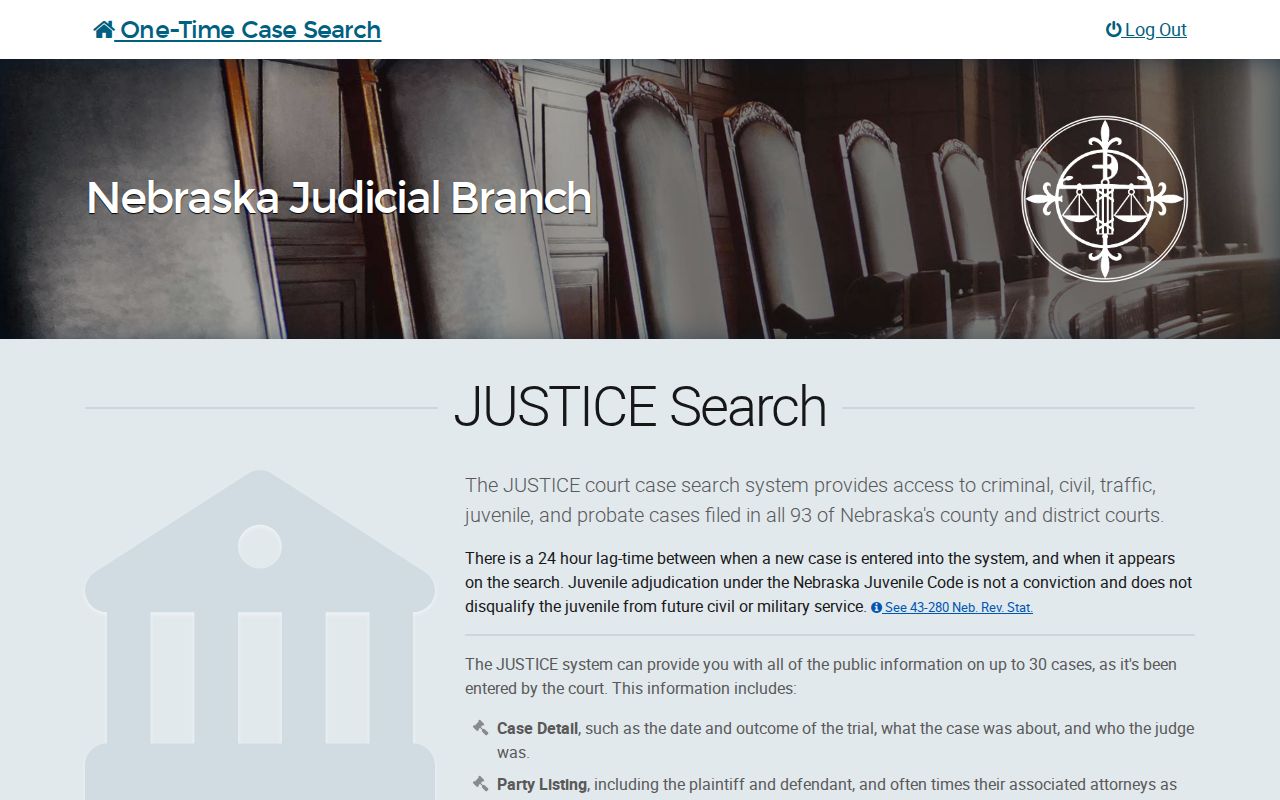
Filtering by County Court or District Court actually means something. Use it with purpose rather than as a guess. When a Thomas County docket search returns too many cases, the portal can narrow things down. Try county, year, case type or subtype, judge, or attorney. One caution on timing. A fresh filing can lag by as much as 24 hours. A search that comes up empty is a reason to check with the clerk. It is not proof that no court record exists.
What a Criminal Docket Shows
JUSTICE displays a case summary plus the register of actions. That register is the court record in chronological order. In a public Thomas County criminal matter, the summary may list the court, case number, parties, case type, filing date, judge, offense information, financial activity, and any nonconfidential images. The entries show what was filed or ordered. Nothing more. They do not prove facts beyond the court action recorded on that date.
| Case number | A state-generated identifier encoding court, county, case type, year, and sequence. A training example uses D93 CI-14-0000019; confirm Thomas coding in the live case record. |
|---|---|
| Charge or complaint | The accusation, offense information where public, and related filing event. A charge is not a conviction. |
| Settings | Arraignment, preliminary hearing, motion, status, plea, trial, or sentencing dates recorded in the register or calendar. |
| Orders and plea | Judge orders and a plea or verdict event, when entered and publicly accessible. |
| Disposition | A dismissal, acquittal, deferred result, conviction, or other recorded outcome, followed by later sentencing entries when applicable. |
Thomas County Criminal Docket Charge Terms
Read the events in order. That habit prevents the classic mistake of treating the first accusation as the final result. A complaint opens the case. An arraignment records the initial response to the charge. A plea, verdict, dismissal, acquittal, or deferred result comes later as procedural information. The register wording and any order control, so an entry saying a hearing was set is not the same as an entry recording the court's final ruling.
- Arraignment
- The early court appearance where the charge, rights, plea, counsel, bond, and next setting may be addressed.
- Preliminary hearing
- The County Court probable-cause stage in a felony case before possible transfer to District Court.
- Bindover
- The step that moves a qualifying felony matter forward to District Court.
- Disposition
- The recorded resolution of a charge or case. Read the exact entry before describing an outcome.
Stages on a Criminal Docket
A Thomas County criminal case usually opens with a citation or complaint. County Court handles the first criminal stage for misdemeanors. It also runs felony preliminary hearings. After a probable-cause finding or waiver, a felony may move up to District Court. Later docket entries can include discovery filings and motions. A plea hearing, a status setting, a trial date, an order, and sentencing may follow. The register gives the sequence. It will not necessarily capture every off-record discussion or exchanged document.
Docket flow: Citation or Complaint › County Court Arraignment › Preliminary Hearing When Applicable › Bindover › Motions, Plea, or Trial › Disposition › Sentencing
Thomas County Criminal Docket Court Split
The Thomas County Court and the Thomas County District Court clerk share the courthouse at 503 Main St in Thedford. Each keeps its own clerk and its own court selection in the state system. Brenda Cochran is the Clerk Magistrate. She is the County Court contact for misdemeanors, traffic, infractions, city ordinance matters, and felony preliminary hearings. Lorissa Hartman, Clerk of District Court, holds the District Court criminal record after felony bindover. The practical takeaway is simple. A County Court felony search that comes up short may need a second District Court search.
Thomas County Criminal Docket Images
JUSTICE can link to nonconfidential images of documents filed or uploaded after April 16, 2008. The scans appear when they exist in the system. An image link is handy for following the public file. An older or paper-only matter, though, may show a register event with no scan attached. The electronic result is also not a certified copy. For a stamped disposition, sentencing order, or complete paper file, give the clerk the court and case number. Then ask for the document.
Which Court Holds Criminal Dockets
County Court is the main Thomas County criminal docket contact for misdemeanor, infraction, traffic, and city ordinance cases. It also records the preliminary phase of a felony. The Nebraska District Court takes over after bindover. It holds the later register, filings, judgments, and criminal orders. Both records may trace one event sequence, yet each is a separate court file. Need a court-date check? The free Multi-Court Case Calendar searches current and future settings by court and county. It is a settings view, not a full criminal register. The chronological history lives in JUSTICE. The clerk can confirm which office holds the record.
Thomas County Criminal Docket Terminal Access
Skip the paid search and use the free JUSTICE terminal at the courthouse. The clerk's office keeps one for public lookups. You can search by party name or case number. Staff can point you to the terminal serving County Court versus District Court. Bring what you know: case number, year, and court. The courthouse sits at 503 Main St, Thedford, NE 69166. County Court answers at 308-645-2266 and District Court at 308-645-2261. Call ahead. The small County Court office has limited staffing.
Need repeated searches of public cases? The Nebraska.gov Subscriber Trial Court Case Search is a different route. It runs list searches. Filter by party name, court type, case type or subtype, county, year, judge, or attorney. Opening a case detail costs $2. Available images come with it at no extra image charge. The annual account fee is $100, though. For one known Thomas County case, the courthouse terminal or a single One-Time Search usually makes more sense.
Want a copy of a public record? The official Thomas County Court profile confirms the County Court contact. Give the clerk the court, case number, case name, document, and date. Then ask to inspect the file, or request a plain or certified copy. A non-attorney may use mail or fax where permitted. Email is not a general court-filing method. Confirm the clerk's preferred delivery and payment method. Do this before sending a written request or using the shared fax number.
Thomas County Criminal Docket Program Context
The District 11 local rules cover court administration. They set the framework for approved problem-solving courts and modified operations across the district. That framework is context only. It does not prove that any particular Thomas County criminal case belongs to a specialty program.
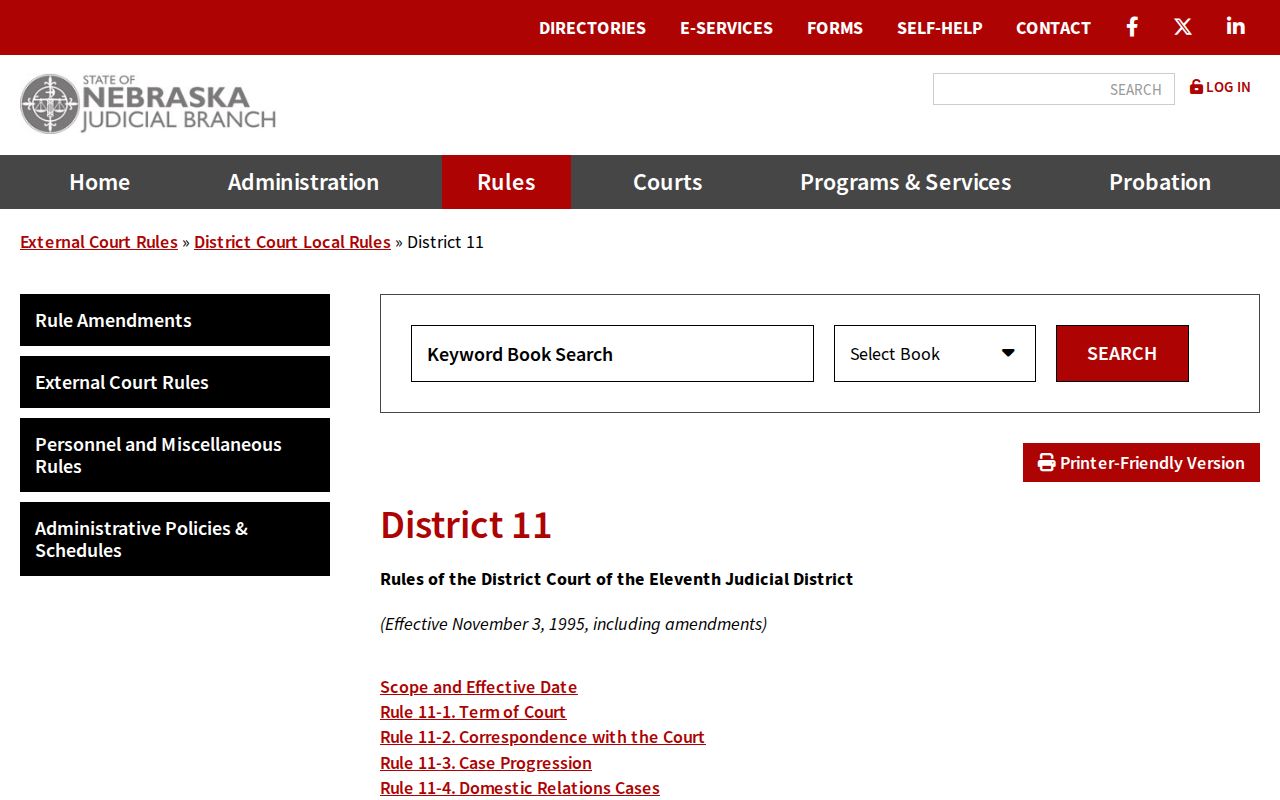
Rules are not records. Trust the case register and current clerk information instead. A general District 11 reference cannot establish a participant's status or disclose treatment information for a specific setting or order.
Thomas County Criminal Docket Regional Resource
Nebraska's official problem-solving court contacts list names the Midwest Nebraska Problem-Solving Court as the District 11 regional resource. It is a starting point for program questions.
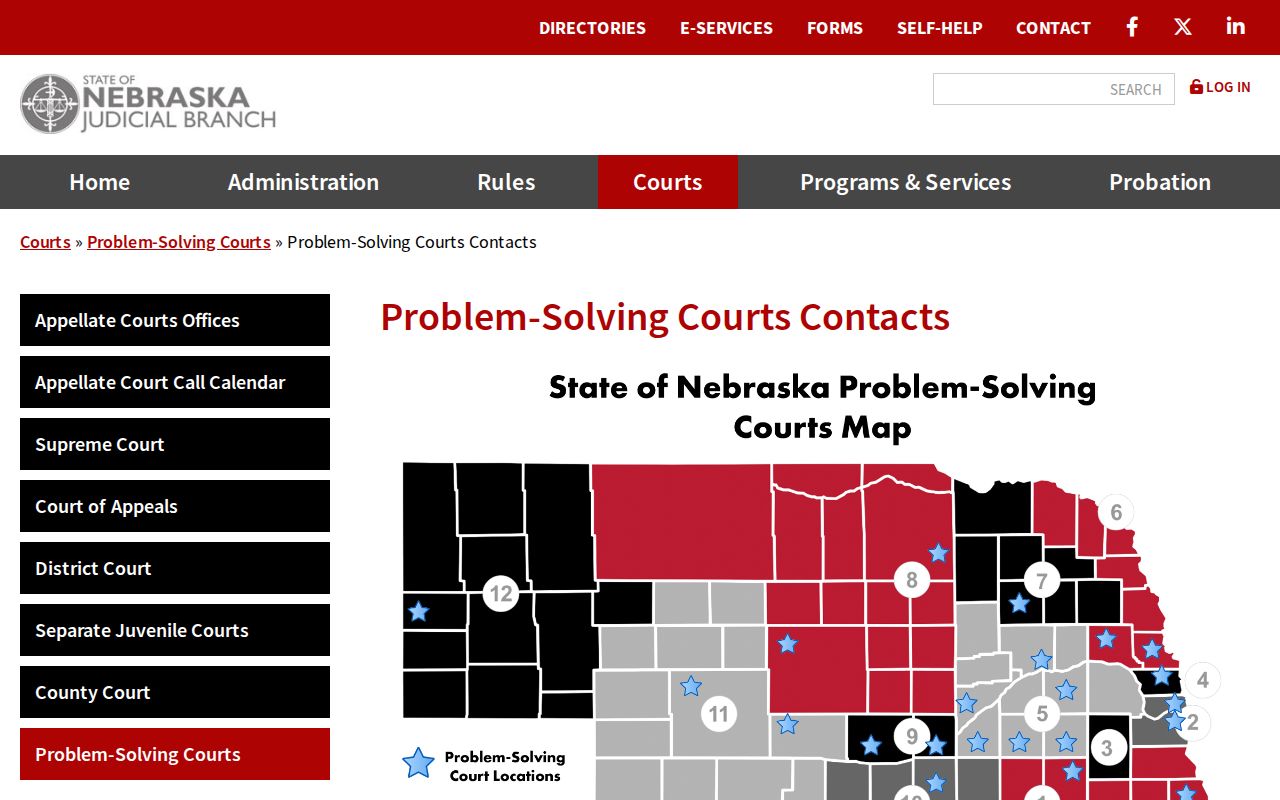
That contact list works for routing a general program question. For a Thomas County docket, order, or calendar question, though, the clerk is the local source. That clerk sits in County Court or District Court. Never infer program participation from a general criminal search result. The docket itself controls.
Thomas County Criminal Docket No-Result Checks
A blank result can mean several things. The record may still sit inside the portal's 24-hour lag. It may be indexed under a different party spelling. Or it falls outside the chosen court or year. Sealed and confidential records stay hidden. So do records older than electronic conversion. Recheck the spelling first. Then search the other Thomas court if the case might be a felony transfer. For an older file, ask the clerk about docket books, microfilm, or archival sources rather than trusting a blank screen.
State recordkeeping guidance treats older court indexes and docket books as permanent records, often kept on microfilm or in archival custody. A modern file has an electronic register and images. An older criminal matter may send the clerk back to a paper-era index. When you ask, name the likely court, the approximate year, the case number if known, and the specific record sought. Those details beat a broad name search.
Public Access and Sealed Criminal Dockets
Nebraska opens its electronic access to party indexes, case summaries, registers of actions, calendars, and judgment or order summaries unless a restriction applies. Juvenile and adoption files are not public docket material. Nor are sealed, protected, or some criminal-history records. A request to seal, a temporary restriction, and a final sealing order are three different events. Read the actual order when one is available. The clerk can explain the records route, but only the court's record decides access to a given item.
Key Rules:
Neb. Ct. R. § 1-805 permits public electronic access to defined court indexes, summaries, registers, calendars, and judgment information unless restricted.
Neb. Ct. R. § 1-808 excludes criminal-history information, adoption records, sealed records, and other protected material from public access.
Neb. Ct. R. § 2-210 requires protected information to be handled through redaction and describes the motion process for sealing a document.